
Sardis: watchfulness among the layers of a city
Revelation addresses a community in Sardis; the ruins preserve a far longer story. Reading both carefully makes the journey richer.
A city with more than one story
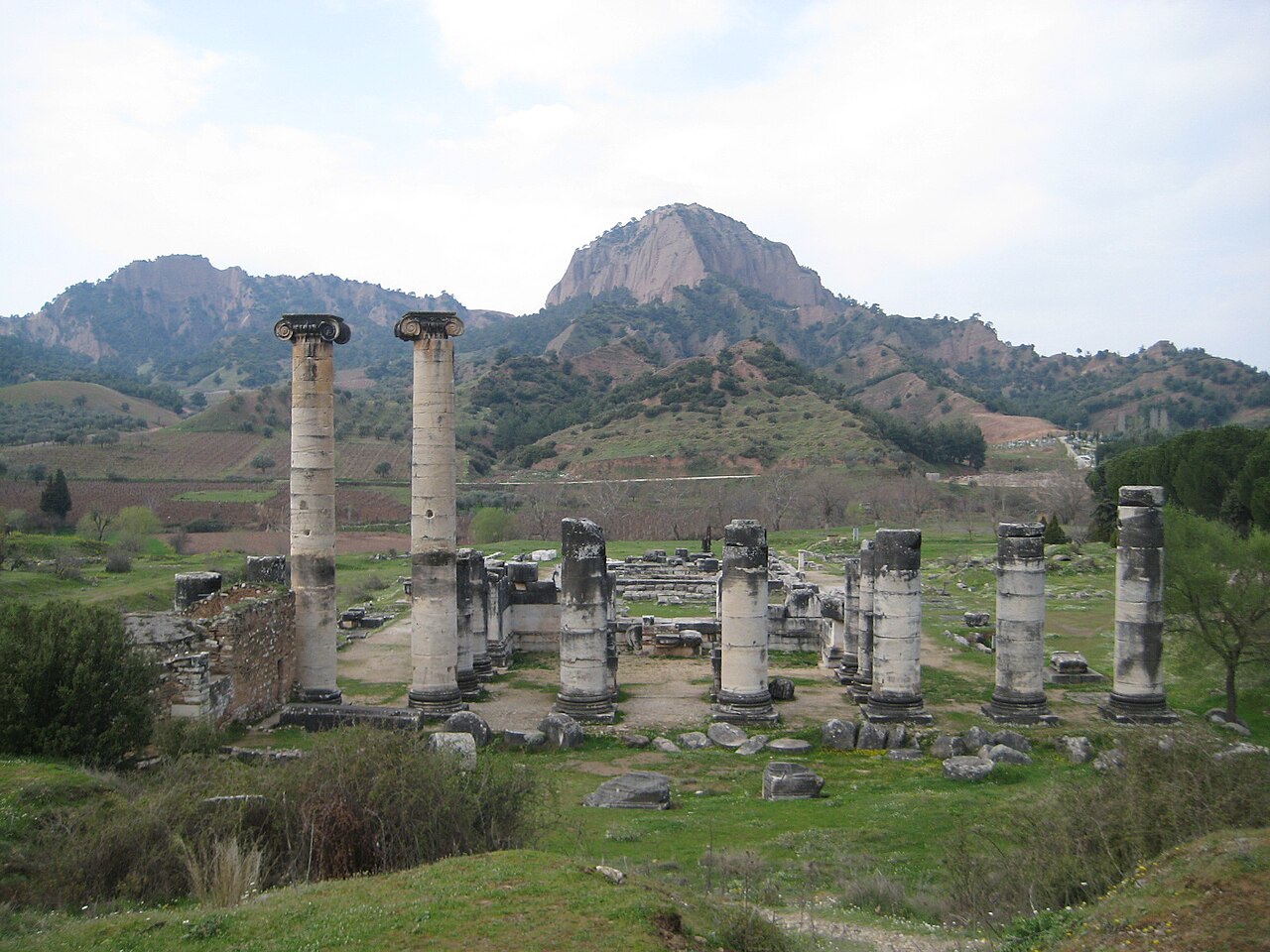
Sardis invites an unusually layered walk. The ancient city near today's Salihli was a Lydian capital, then a place shaped by Greek, Roman, Jewish and Christian lives. The Turkish Ministry of Culture and Tourism names the Temple of Artemis among its important surviving monuments. The Archaeological Exploration of Sardis describes a monumental synagogue and a small later church near the temple. These places can be visited within one landscape, but they were neither built at the same moment nor used by the same community.
The voice of Revelation
Revelation 3 addresses the church in Sardis with a call to wakefulness. Its message speaks of a reputation for life that does not match reality, urges the community to strengthen what remains, and asks it to remember what it received. The text also acknowledges people who have remained faithful. It is a spiritual appeal to a community, not a survey of buildings or a visitor's guide to the ruins. A group can read it slowly and ask what alertness and shared responsibility might mean now.
The chapter does not point to the Temple of Artemis, name a synagogue building, or describe Church M. Nor does an excavated wall verify the moral condition of the congregation. Scripture gives us an early Christian voice associated with the city. Archaeology offers evidence about the city's material life across different periods. They can illuminate one another without becoming the same kind of source.
The great temple and its changing surroundings
The Temple of Artemis is a powerful visual landmark. According to the Sardis excavation project, construction began in the Hellenistic period, while Roman interventions altered its interior and added columns. Two complete columns have remained standing since antiquity. Their scale helps a visitor sense a city with religious practices and public ambitions beyond the story of its Christian community. The temple was dedicated to Artemis; calling it an early church would erase the purpose for which it was made.
The project's account also traces later Christian marks in the precinct. Crosses and short religious words were incised near an entrance, and a small church stood by the temple's eastern end. These changes belong to late antiquity. They show a transformation of the site over time, not a first-century conversion of the entire sanctuary. On a guided walk, even a modest mark in stone can open a thoughtful conversation about continuity, change and the care needed when describing another tradition's sacred place.
Church M belongs to a later chapter
The excavation team calls the small building near the southeast corner of the temple Church M. It was probably established in the later fourth century and remained a place of Christian worship into the early seventh century. Its compact plan, built from brick, fieldstone and reused marble, differs strikingly from the scale of the neighbouring temple. The structure gives material evidence for later Christian life at Sardis. Its name is an archaeological label, not a reference in Revelation.
This is where a guide's wording matters. It would be tempting to stand beside Church M and say, 'Here is the church that received the letter.' The evidence does not support that identification: the building is centuries later than the biblical text. We can instead say that Christian worship continued in the city and took visible architectural form in a later age. That statement is both more accurate and more moving, because it leaves room for generations of people between the text and the surviving walls.
A synagogue in the same city
Sardis also preserves an important record of Jewish life. The excavation project describes a monumental synagogue incorporated into a corner of a Roman bath and gymnasium complex. Much of its surviving decoration belongs to the fourth and fifth centuries. The building was discovered in 1962 and has been partly restored. Its large hall and elaborate surfaces speak of a substantial later community, but they should not be confused with an otherwise unspecified setting for the first-century Christian letter.
What the stones can tell us
A ruin may establish that a structure existed, show how it was altered, and preserve traces of how people used a place. Excavators can compare masonry, coins and decoration to propose dates and building phases. The Sardis project's accounts of the temple, Church M and synagogue make those distinctions visible. Yet a stone cannot tell us exactly what a worshipper thought, and a later church cannot supply a photograph of the congregation named in Revelation. Interpretation remains necessary, even where physical evidence is strong.
A slower way to visit
Begin with the setting: hills, open ground and the size of the ancient city. At the temple, look at the surviving columns before searching for later Christian marks. Let Church M remain a small building with its own history rather than making it stand for every century of Christianity. If the route includes the synagogue, allow time to consider its scale and its distinct Jewish story. A guide can then read Revelation 3 in a quiet place, identifying clearly what comes from the text and what comes from the excavation.
Paths across archaeological sites can be uneven, and access to particular areas may change. A group itinerary should allow a comfortable pace and confirm current conditions before travel. Sardis rewards pauses more than hurried photographs. Its strongest lesson may be the discipline of looking twice: first at what is present, then at what we are tempted to assume. The biblical invitation to watchfulness can become a way of travelling attentively, while the city's many layers remain fully themselves.