
Philadelphia: an open door and surviving pillars
Revelation praises a community with little strength. Alaşehir preserves a later church whose pillars tell a different, equally meaningful chapter.
A city beneath a living town
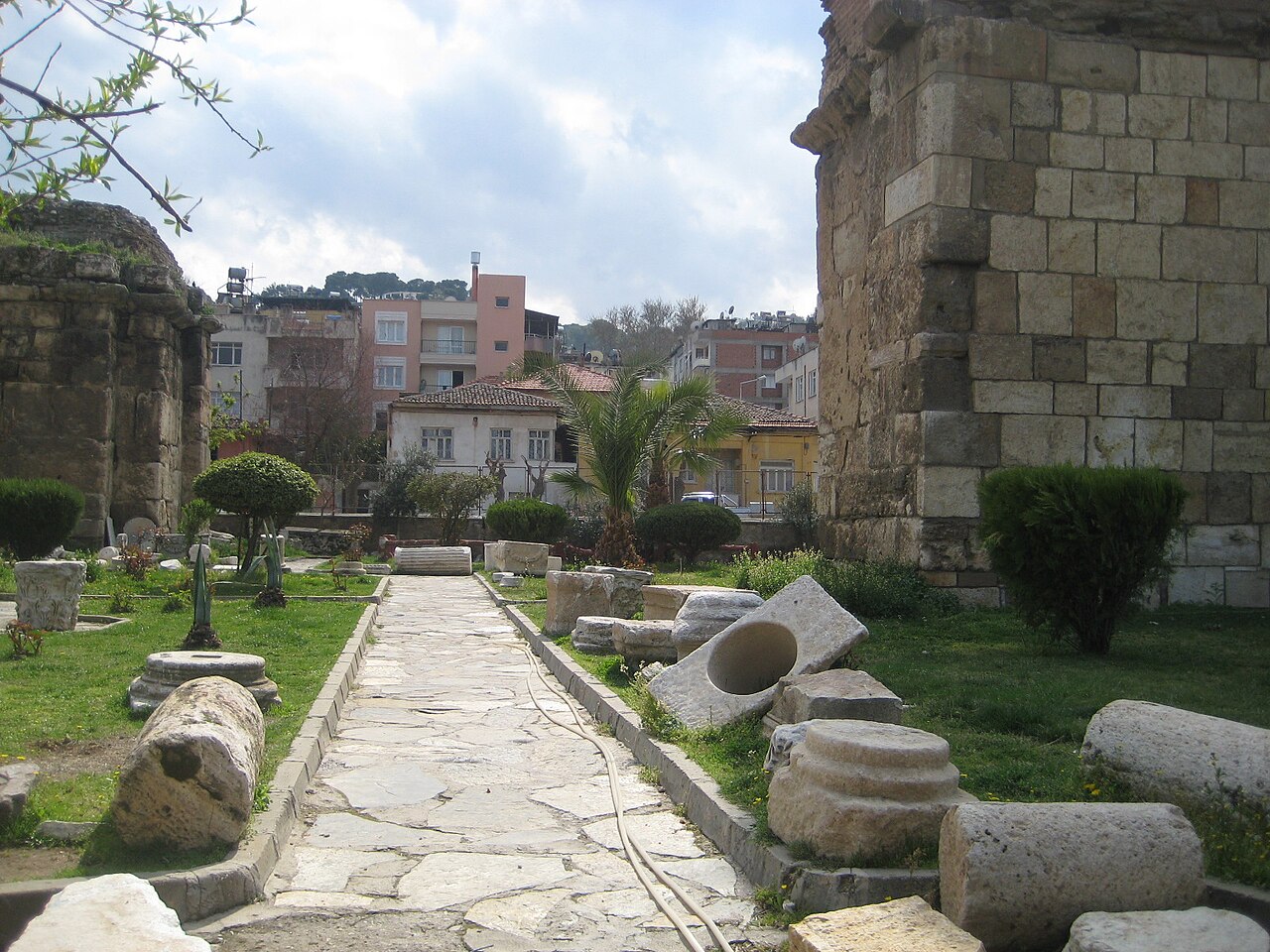
Ancient Philadelphia lies within modern Alaşehir in Manisa province. The city is not encountered as a complete, empty archaeological park. Streets and ordinary town life share the ground with fragments of older walls and monuments. The Manisa culture directorate places Philadelphia beneath Alaşehir and identifies Toptepe as its ancient acropolis. It records a temple site on the plateau, remains of an early Roman theatre on its northern slope, Byzantine walls and an eastern gate. This scattered setting asks visitors to read the city in layers. The landscape is real, but it cannot be made to look like a single preserved scene from the New Testament.
What Revelation says
Revelation 3:7–13 addresses the church in Philadelphia. Its speaker is described as holy and true, holding the key of David. The community is told that a door has been opened before it. Although its strength is limited, it has kept the word and not denied the name of Christ. The message calls its hearers to hold fast and promises that the one who prevails will become a pillar in God's temple and receive new names. It closes with the familiar invitation to hear what the Spirit says to the churches. These are images in a prophetic letter, not a visitor's inventory of excavated objects.
The passage also contains sharp language about a rival assembly. It belongs to an ancient dispute voiced by the text; it must never be applied to Jewish neighbours today. Reading responsibly means naming the polemical language without turning it into a judgement on contemporary people. A group can attend to the letter's themes of endurance and faithfulness while rejecting antisemitic use of its words.
An open door is not a measured gateway
The biblical footnotes explain the open door as an opportunity for sharing and proclaiming faith. The key of David conveys authority; it does not identify a metal key found at Alaşehir. Likewise, the promise of a pillar concerns the victorious believer within the passage's vision of God's temple. Visitors sometimes look at the surviving pillars of St. Jean Church and imagine that Revelation was describing those exact stones. That is a memorable visual connection, but it reverses the chronology. The sixth-century monument did not stand when the first readers heard the letter. Its pillars may help a modern group remember the metaphor; they are not archaeological proof of its original meaning.
The later church that can be seen
Türkiye's Ministry of Culture and Tourism dates St. Jean Church to the early Byzantine period, specifically the sixth century. It reports three monumental structural supports still standing. The ministry also notes reused carved stones and column pieces from earlier buildings in its construction. These details tell a material story: Christian builders worked within an older city and reused available architectural elements. The surviving supports suggest the scale of the church, although their presence alone cannot reconstruct every feature of its original plan or liturgy.
The ministry's Alaşehir archaeological guide lists the church alongside Toptepe, theatre remains, walls and gate. Each feature has a different date and purpose. A visit should therefore resist one simple label for the whole area. The church is a witness to later public Christian life. It is not the meeting place that Revelation names, because Revelation gives no address for the first-century community and the standing church is several centuries younger.
A name with a long history
The local culture directorate says the ancient city was founded by Attalus II of Pergamum in the second century BCE and first bore the name Philadelphia. The US Catholic bishops' note to Revelation identifies it with today's Alaşehir and recalls an earthquake in AD 17 followed by imperial assistance in rebuilding. These historical frames can enrich a reading of the letter's language about strength, stability and a new name. Yet the footnote offers possible allusions, not a transcript of what every member of the original congregation thought. A city can endure several names and many rebuilding campaigns; no one monument contains its whole identity.
What stones can and cannot answer
Archaeology can establish that a later church stood here and that earlier material was incorporated into it. The visible remains can show construction choices and the persistence of Christian memory in the city. They cannot verify that the original recipients of Revelation gathered on this exact plot, or tell us how large their community was. Scripture gives a message to believers; surviving masonry gives evidence of later building. Tradition and pilgrimage connect those layers because the place continued to matter. Keeping the layers distinct allows each source to say what it can actually support.
Reading in the shade of the pillars
For a thoughtful group visit, read Revelation 3:7–13 before approaching the church remains. Listen for the contrast between limited strength and an enduring promise. Then look at the supports and ask a different question: what do they reveal about sixth-century Christian architecture in Philadelphia? The ministry's guide can orient the group to other remains in the town. There is no need to manufacture a direct physical link between letter and masonry. The contrast itself is compelling: a brief text addressed to a vulnerable community, and a much later monumental expression of faith in the same city.
A journey of attention
Alaşehir is a living place, so a route should respect residents and the practical conditions of a town rather than treat it as an abandoned biblical set. Confirm access and local arrangements before travel; conditions around monuments can change. Allow time to observe the church's reused stone, the scale of its supports and the wider topography of Toptepe. Leave room for discussion of the text's difficult language as well as its hopeful images. Philadelphia rewards patient attention because it holds both an early written witness and later architectural memory. Neither has to stand in for the other. Together they invite a more honest encounter with Christian history in Anatolia.