
Pergamon: faith on a layered hill
What the letter in Revelation says, what the ancient city preserves, and why the difference matters on a journey to Bergama.
A city above and below
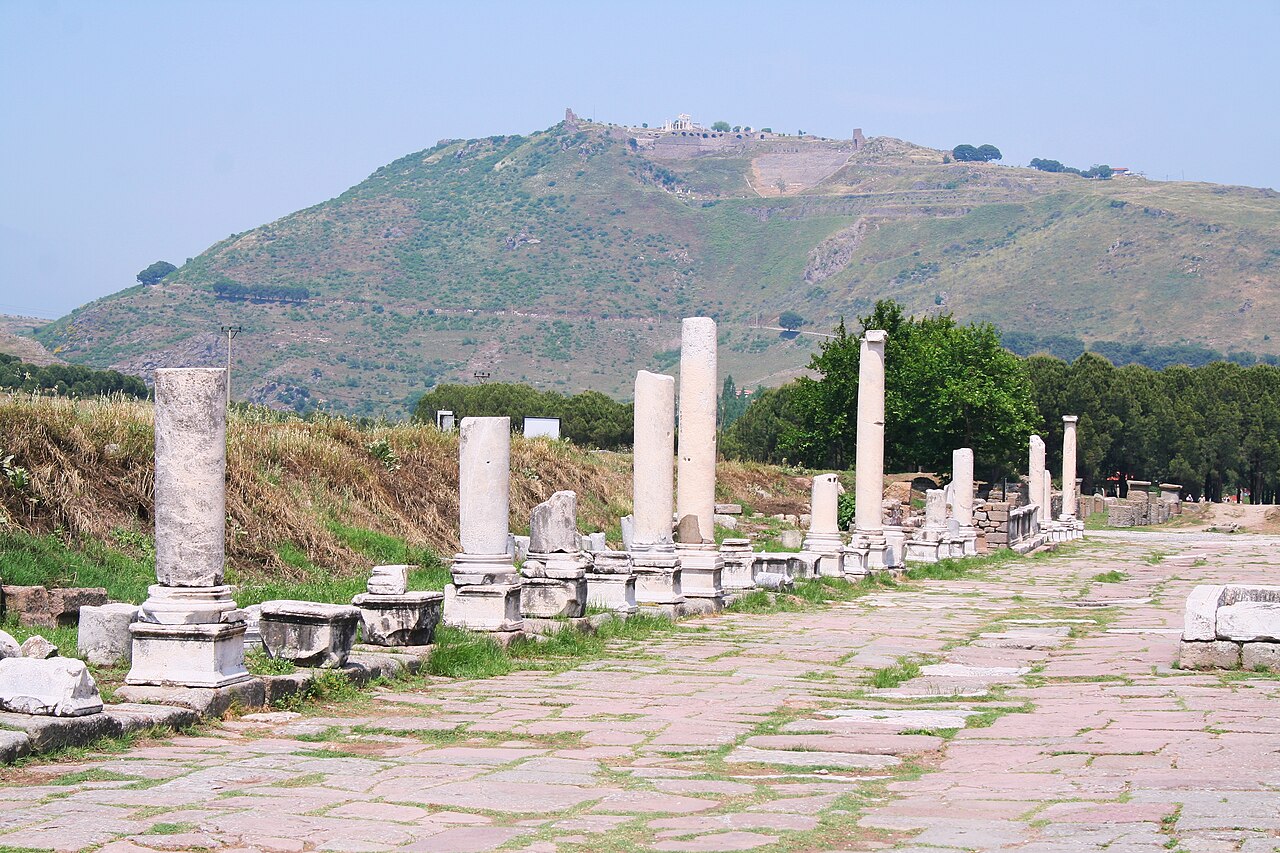
Pergamon does not reveal itself in a single view. From the plain near modern Bergama, the hill draws the eye upward; on the slopes and below them, other parts of the ancient city tell their own stories. UNESCO describes a landscape shaped by Hellenistic, Roman, Byzantine and Ottoman lives. The acropolis was the capital of the Attalid dynasty and a centre of learning. Later, Roman structures and religious spaces added new meanings. A visitor looking only for one biblical landmark can miss the city in which an early Christian community actually lived.
This layered setting is a gift to a pilgrimage. It asks us to slow down before attaching a verse to a stone. The people addressed in Revelation inhabited a working city, not a collection of ruins. They moved among public buildings, inherited traditions and demands on their loyalty.
The letter to Pergamon
Revelation 2:12–17 addresses a community under pressure. The message commends people who held fast to their faith, even while recalling Antipas, named in the text as a faithful witness killed among them. It also warns against compromise within the community and ends with images of hidden manna and a new name. These are words of encouragement and correction, not a tourist map. Reading the whole passage matters: its praise and its challenge belong together.
The letter calls Pergamon a place associated with Satan's throne. Readers have long asked what that image points to. The city had several powerful religious and civic monuments; imperial worship and other cults were part of its wider environment. The biblical phrase may evoke that world of power and allegiance. But the passage does not supply an archaeological label to place on one remaining structure. A guide can describe possible interpretations without claiming a certainty the text does not give.
The acropolis and its scale
On the acropolis, the steep terrain shapes the experience as much as any individual monument. UNESCO identifies a theatre, terraces, temples, porticoes, a gymnasium, an altar and a library within the Hellenistic urban design. The Turkish Ministry of Culture and Tourism likewise describes the theatre set into the hillside. These features speak of a city that displayed cultural ambition and political authority long before the letter in Revelation was written. They also help visitors imagine how impressive public life could appear to a small religious minority.
It is tempting to point at a grand ruin and say that this must be the throne mentioned in the letter. That makes for a memorable sentence, but it turns interpretation into supposed proof. The acropolis is valuable without that shortcut. Its height, engineered spaces and broad outlook make the scale of ancient Pergamon tangible. Stand there, read the passage, and allow the contrast between visible power and quiet fidelity to remain a question rather than a forced identification.
More than a hilltop
The UNESCO inscription includes a wider cultural landscape, not only the upper city. The Asclepieion recalls ancient practices of healing. The Red Basilica, originally associated with the worship of Serapis, belongs to another stage of Roman Pergamon. Its later uses include Christian worship and, in different spaces and periods, Jewish and Islamic worship. Such changes show how a place can be inherited and reinterpreted by successive communities. They should not be collapsed into the first-century setting of Revelation.
What the text cannot show us
Revelation gives a voice to a community, but almost no physical description of its meeting place. The named witness Antipas belongs to the letter's testimony. Later stories about him may be meaningful to different traditions, yet they require separate evaluation and should not be presented as if Revelation itself supplied their details. Archaeology can establish the setting of a city; it cannot independently verify the private courage of every person whom the text addresses.
This does not diminish the journey. It makes room for honest listening. Ask which claims come from the biblical passage, which are grounded in surviving architecture, and which arise from later remembrance. Travellers of different Christian backgrounds can share that careful method even when they interpret particular images differently. An attentive pilgrimage has space for conviction and for intellectual humility.
A way to walk Bergama
Begin with the landscape. Look up to the acropolis from below, then consider how the upper city and lower districts belonged to one lived environment. At the acropolis, give time to the theatre and the views rather than hurrying from monument to monument. Read Revelation 2:12–17 in full at a quiet point. The aim is not to recreate a scene from the text, but to hear its questions about courage, pressure and compromise in a place where public authority was visible.
If time and access allow, include the Red Basilica as a later chapter, with its changing religious uses explained clearly. Conditions, opening arrangements and walking demands should always be checked when a group plans its route. The hill and its paths call for an unhurried pace. A good itinerary leaves room for rest, conversation and the simple act of looking closely.
The question that travels onward
The strongest impression Pergamon leaves may not be a single photograph. It may be the tension between the impressive city and the letter's appeal to remain faithful. Revelation's words were directed to people negotiating life amid competing loyalties. Their exact circumstances cannot be read from a wall, yet the place can help modern readers ask what fidelity looks like when public expectations feel overwhelming.
Pergamon rewards the traveller who lets the text and the landscape speak in their different ways. The acropolis reveals ambition and endurance in stone; the letter asks about trust, integrity and change of heart. Neither substitutes for the other. Together they make Bergama a place to carry a question home, beyond the hill and beyond the day's itinerary.