
Laodicea: a letter, a city and a later church
The New Testament addresses people in Laodicea; the surviving church belongs to a later century. The distance between them is part of the story.
Begin with the place
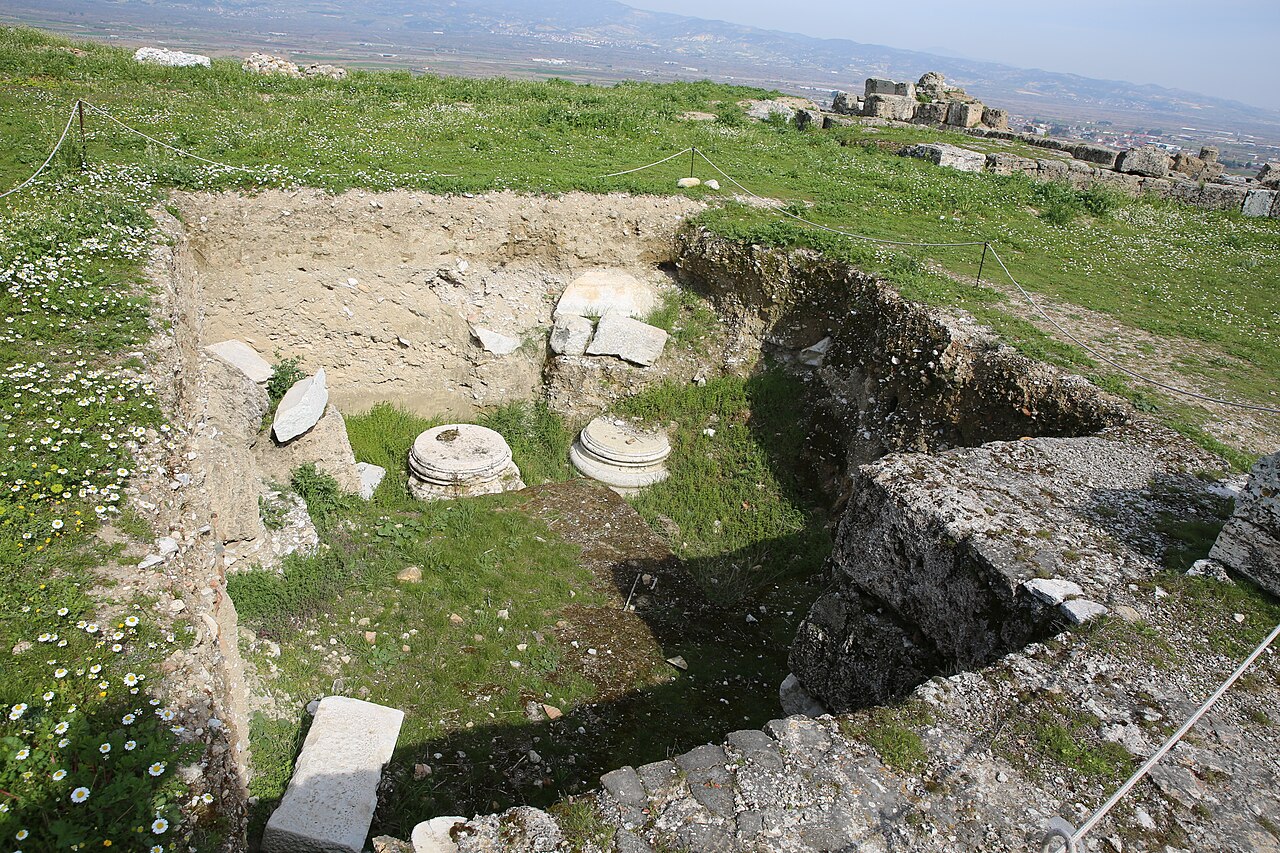
Laodicea stands in the Lycus valley near modern Denizli. The provincial culture directorate places the site about six kilometres north of the city, while Türkiye's UNESCO tentative-list submission describes a plateau between waterways and major routes through Anatolia. A visitor meets an extensive urban landscape rather than one isolated church. Streets, theatres, baths, waterworks and later Christian buildings belong to different phases. Before opening a Bible, it helps to look across the valley and remember that ancient communities lived within a busy city with trade, neighbours and changing political fortunes. A route through the ruins should make room for that wider setting.
What the biblical texts actually say
Revelation 3:14–22 addresses the church in Laodicea. Its speaker challenges a community that claims to need nothing, yet is described as spiritually poor. The passage uses images of heat and cold, gold, clothing, sight and a door at which Christ stands. It ends with an invitation to listen and a promise to those who overcome. The text is a pastoral and prophetic appeal; it does not draw a plan of the city or identify a surviving building.
Colossians 4:13–16 offers another window. It names believers in Laodicea alongside Hierapolis, sends greetings to a house church associated with Nympha, and asks for letters to be exchanged between communities. The passage is evidence of a network of readers and worshippers. It does not locate Nympha's house among today's excavated walls. Nor should the reference to a letter from Laodicea be turned into a confident claim about a particular lost manuscript: the biblical note itself acknowledges uncertainty about its identity.
Prosperity in the landscape
The local culture directorate describes Laodicea as a crossroads and records the importance of wool and textile production. Its historical account says the city rebuilt itself after the earthquake of AD 60, while nearby places received outside help. Such details provide a useful backdrop for Revelation's language of wealth and clothing. They make the rhetoric intelligible in a prosperous urban setting, but they do not prove that a specific merchant heard the letter or that every resident shared the same attitude. Archaeological and historical evidence explains the city's economy; the scriptural text addresses the moral condition of its community.
Hot, cold and careful interpretation
The language of being neither hot nor cold is memorable enough to dominate many visits. The notes accompanying the biblical text suggest a possible allusion to the hot springs near Hierapolis. That is an interpretation, not a measured description of water in a first-century Laodicean household. The city's water-distribution structures are real archaeological features, yet a pipe cannot by itself settle the metaphor. A good guide can point out the valley's geography, explain the proposal and still let the force of the passage rest on its call to earnest response. That approach keeps a vivid idea from hardening into an unsupported fact.
The church found by excavators
Visitors can now encounter a substantial later Christian building. The Denizli culture directorate reports that the Laodikeia Church was identified during excavations in 2010. It describes a baptistery room with a marble-clad, cross-shaped font and says a protective roof and glass walkways allow visitors to see the remains. The directorate dates its construction to the age of Constantine after Christianity gained legal freedom in the fourth century. The UNESCO tentative-list account likewise describes the Laodikeia Church as a fourth-century structure.
That date matters. The building is powerful evidence for Christian life in the later Roman city, but it is centuries younger than the New Testament communities. It cannot be labelled the meeting place of the people addressed in Revelation. We can value the excavated church more fully by allowing it its own time: a period of public Christian worship, monumental architecture and changing urban space. The cross-shaped font speaks to baptismal practice in that later period, not to an object named in the letter.
A city that kept changing
The tentative-list description names two theatres, baths, agoras, gates, fountains, streets and several churches. It also records repeated earthquakes, rebuilding and eventual abandonment after a severe event in the early seventh century. A street may therefore contain stones moved or reused long after the first people walked there. An impressive restoration can help visitors read a building, but it is still an interpretation of surviving material. Looking carefully at dates prevents the whole site from being treated as a fixed backdrop for one biblical episode. Laodicea was inhabited, repaired and reshaped across many generations.
Reading without collapsing the centuries
Three layers can be held together without confusing them. Scripture gives voices directed to early believers: the admonition in Revelation and the greetings in Colossians. Excavation gives material evidence for a city with public infrastructure and later church buildings. Subsequent Christian memory gives the place its enduring importance for pilgrims. None of these layers needs to impersonate another. The biblical message does not require the fourth-century church to be its original address, and the later church does not become less meaningful because it was built later. Its very existence shows how Christian practice took visible form across time.
A thoughtful visit
Begin on one of the broad streets and notice how large the city was. Pause at a water feature or civic building to imagine daily movement through a commercial centre. At the church, look for the protected baptistery and ask what its architecture can actually tell us about later worship. Then read Revelation 3 in a quiet place, distinguishing its language from the stones around you. Colossians 4 can add a sense of relationships between the valley's communities. Site access and walking conditions can change, so confirm them when planning a group route. Allow time for questions, not only photographs. Laodicea rewards a journey that listens to the text and sees the archaeological landscape on its own terms.
Sources & further reading
- Revelation 3 · United States Conference of Catholic Bishops
- Colossians 4 · United States Conference of Catholic Bishops
- Laodikeia · Denizli Provincial Directorate of Culture and Tourism
- Laodikeia excavation and church · Denizli Provincial Directorate of Culture and Tourism
- Archaeological site of Laodikeia · UNESCO Tentative List